
Their goofy handshake may have looked like an homage to the Marx Brothers, but the shared commitment of President Barack Obama, Canadian Prime Minister Justin Trudeau and Mexico's President Enrique Pena Nieto to see half of the continent’s electricity generated by clean sources by 2025 is serious and far reaching.
The Canadian, U.S. and Mexican leaders have agreed to a trilateral energy and climate plan that sets new goals for emission reductions, and paves the way for joint development of low-carbon technologies and a dramatic increase of electricity exports from Canada.
At the North American leaders’ summit on Wednesday, the leaders committed to a continent-wide goal of having 50 per cent of all electricity come from clean-energy sources by 2025, an increase from the current 37 per cent; a reduction in methane emissions from the oil and gas industry of 40 per cent to 45 per cent; and cuts in two other potent greenhouse gases.
They also agreed to work together on research and development projects aimed at commercializing clean technology, including demonstration projects in areas such as energy storage, and the capture of carbon dioxide for use as an industrial feedstock or for sequestration underground.
Obama, Trudeau and Pena Nieto completed the one-day summit in Ottawa Wednesday, where
climate change at the center of efforts to deepen the North American alliance, pledging to cut greenhouse gas emissions from the oil and gas sector, boost the development of clean power and build new cross-border transmission lines.
“For too long, we’ve heard that confronting climate change means destroying our economies,” Obama said in a speech to Canada's Parliament Wednesday after the summit concluded, praising efforts in Canada and the U.S. to cut emissions and drive growth. “This is the only planet we’ve got and this may be the last shot we’ve got to save it. And America and Canada are going to have to lead the way.”
The pledges, in what was was Obama’s final North American Leaders’ Summit, underscore a renewed push to strengthen an alliance that had been soured by the rejection of TransCanada Corp.’s Keystone's XL pipeline last year. The improved continental ties were fueled in part by the election of Trudeau’s pro-environment Liberal Party to power last year.
The clean energy push includes the development of cross-border electrical transmission projects to boost capacity for trading of clean energy and for reliability and flexibility of the continent’s energy grid, the leaders said.
North America’s use of clean energy stood at roughly 37 percent in 2015. Reaching the new target, described as a “goal,” would grow U.S. clean energy production to 1,900 billion kWh, the White House said Wednesday. Mexico will also join the U.S. and Canada in reducing methane emissions from the oil and gas sector by 40 to 45 percent by 2025, with the three countries pledging a methane reduction strategy in agriculture and waste management.
The Three Amigo's have puts us on a critical reduced emission trajectory, whether they can figure out the handshake or not.
Image may contain: 3 people, people standing, suit and outdoor
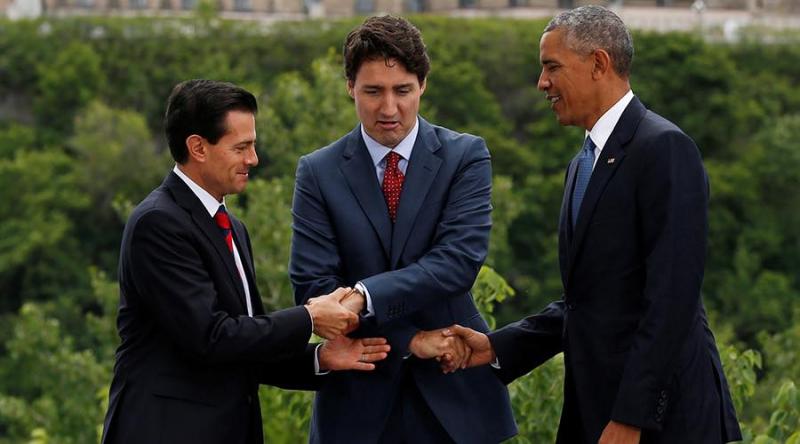
Photo courtesy of Chris Wattie / Reuters.
