


Currently, the U.S. federal government has shifted its stance on scientific investment, reducing support and enforcement for research and development, particularly in biological health and environmental fields. While this creates a major challenge, it also presents an opportunity. A reduced federal role can compel states and regions to restructure their environmental focus, fostering innovative collaboration to address urgent local and transboundary concerns. This essay will argue that such regional cooperation is not merely a stopgap measure but a robust and proactive model, exemplified by coalitions like the Pacific Coast Collaborative.
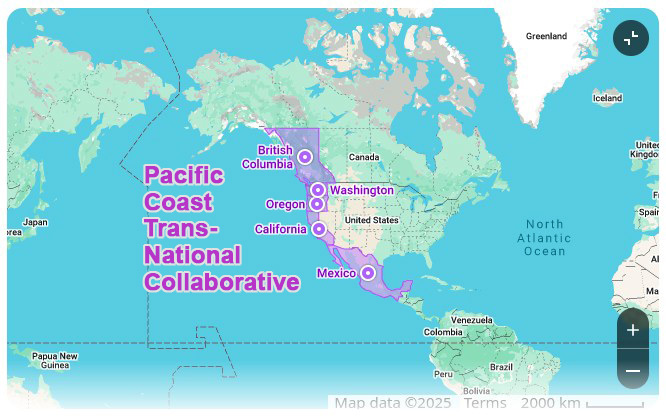
The states along the Western seaboard, led by California, the world’s fourth-largest economy, have a clear obligation to address the environmental impacts of their industrial and societal footprints. The region’s unique position makes it a critical actor in protecting both its own infrastructure and the broader environment. In response to these pressures, California, Oregon, Washington and British Columbia, Canada, have entered into regional agreements like the Pacific Coast Collaborative (PCC). While the Border 2025 program, primarily an EPA initiative involving Mexico and California, which is more of a continuation of a 1983 binational initiative, also illustrates the potential for international partnerships to manage shared ecological issues.
While carbon emissions are a significant concern across the continent, these regional coalitions highlight a more specific and pressing issue: the scientific brain drain resulting from recent federal deregulation. The focus here is not simply on mitigating climate change but on empowering the very scientists and researchers who have been adversely affected by the retreat of federal support. By organizing through state-level compacts, researchers can find new avenues for funding and collaboration, ensuring their vital work continues.
The Pacific Coast Collaborative and similar agreements should serve as a model for other regions navigating the complexities of reduced federal oversight. Their success demonstrates that coalitions can overcome regulatory setbacks that have impacted environmental industries nationwide. This approach fosters a new era of scientific resilience and innovation.
The environmental community and its allies must recognize that the expertise of scientists is more critical now than ever. The ideation process for solving environmental challenges must never be stifled. The demand for a healthy environment is a constant public good, and the aspiration for scientific equity, ensuring that research addresses the needs of all communities, will always command both a social and a financial market. By embracing regionalism, environmental research can not only survive but thrive in this new landscape.
Resources:
Pacific Coast Action Plan on Climate and Energy
Images courtesy of Google Maps
