

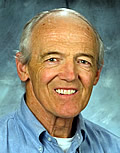
 Dr. Arthur Gossard is a professor of Materials and Electrical Engineering at the University of California in Santa Barbara. In 1982 he co-discovered the fractional quantum Hall effect. His research is related to molecular beam epitaxy (MBE). He holds a B.A. from Harvard, a Ph.D. from UC Berkeley and was formerly a Distinguished Member of the Technical Staff of AT&T Bell Laboratories. Gossard grew the first alternate monolayer artificial superlattices in semiconductors and the first modulation doped quantum wells. He was also co-discoverer of the quantum confined Stark effect and the fractional quantization of the Hall Effect.
Arthur Gossard’s special interests are molecular beam epitaxy, the growth of quantum wells, superlattices, magnetic semiconductors and metal/semiconductor nanocomposites and their applications to high performance electrical and optical devices and the physics of low-dimensional structures. A member of the Center for Energy Efficient Materials (CEEM), Gossard contributes to research on metal/semiconductor nanocomposites that will allow the modification of intrinsic material properties that are important for high efficiency thermoelectrics.
Honors
- The American Association for the Advancement of Science (AAAS) Newcomb Cleveland Prize, 2005, 2006
- James C. McGroddy Prize for New Materials from American Physical Society, 2001
- Member of the National Academy of Sciences since 2001
Return to Board Members Index
