

Environmental Research Advocates is proud to have played a role in the introduction of David Fransen, Consul General of Canada in Los Angeles, to Paul Weiss, California NanoSystems Institute (CNSI). This relationship has resulted in the establishment of annual Canada Fulbright Chairs at CNSI. The Fulbright Program was established in 1946 with the mission to enable academic exchange and public diplomacy between countries. Fulbright Canada, which recently celebrated its 20th year, aims “to enhance mutual understanding between the people of Canada and the people of the United States of America by providing support to outstanding individuals. These individuals conduct research, lecture, or enroll in formal academic programs in the other country” (Fulbright Canada Mandate).
Canadian Fulbright Scholars discussed nanotechnology applications in the renewable energy and biomedical fields on May 14, 2013 in Westwood, CA.
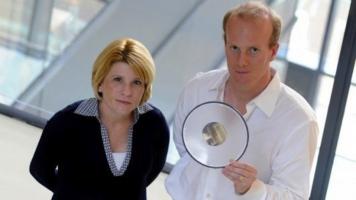
Ted Sargent and Shana O. Kelley, recipients of the 2012-13 Canadian Fulbright Scholar Awards, presented their research on nanotechnology to a group of students, professors and scientists at the California NanoSystems Institute (CNSI) at UCLA. Their groundbreaking work involves the application of nanotechnology to developing solar energy and biomedical technologies.
Ted Sargent, a Professor in the Department of Electrical & Computer Engineering at the University of Toronto, holds the Fulbright Visiting Research Chair at CNSI UCLA, focusing his research on inorganic colloidal Quantum Dot solar cells. Quantum dots are nanotechnology-produced semiconductors, and are a potential replacement for the silicon semiconductors that are generally used in photovoltaic cells. Incorporating Quantum Dots in solar cell synthesis poses potential advantages to renewable energy production; Silicon semiconductors convert light into electricity, but use a limited energy range of photons. Dr. Sargent described his work developing tandem Quantum Dot solar cells, which are able to process a broader range of photon wavelengths – and even infrared light – into electricity, so less potential energy is wasted in the process. Dr. Sargent also works extensively with colloidal Quantum Dot solar cells, which are three-dimensional (as opposed to standard planar ones), and can convert photon energy with up to 7% energy transfer efficiency. This research is a promising development in renewable energy technology as energy consumers search for more efficient and affordable solar panels.
The topic of the lecture switched from renewable energy to biomedical research when Shana O. Kelley, the special Fulbright Canada Fellow at CNSI UCLA , took the stage. Also a Professor of Biochemistry at the University of Toronto, Dr. Kelley presented her research on applying ultra sensitive molecular detectors to medical equipment. By using electro-chemical bio-sensing enabled by nanotechnology, Dr. Kelley hopes to create faster, cost-effective, and reliable diagnostic methods.
CNSI is a multi-disciplinary research program with locations at both UCLA and UC Santa Barbara. Its mission is “to encourage university collaboration with industry and to enable the rapid commercialization of discoveries in nanoscience and nannotechnology.” Research at CNSI applies to four main areas: Energy, Environment, Health-Medicine, and Information Technology.
Congratulations to Paul Weiss and to David Fransen for their combined vision in the creation of two Fulbright chair positions at CNSI UCLA. We'd also like to take this opportunity to thank both Paul and David for their continued friendship and inspiration.
