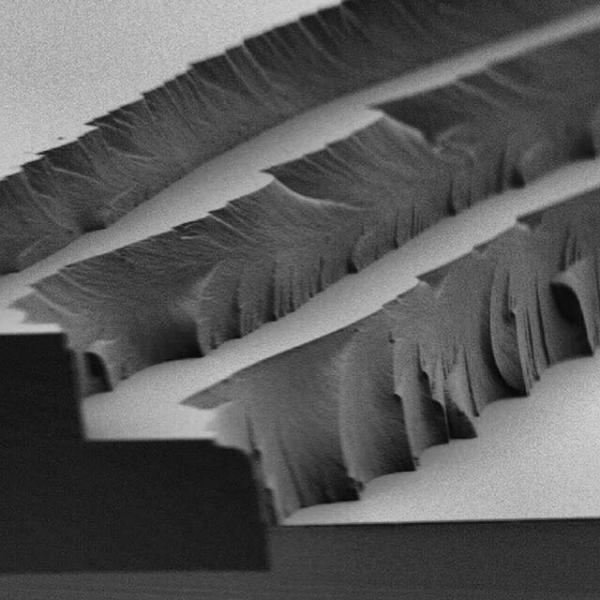


What does the accompanying image bring to mind? Layers of carved chocolate? How about a block of clay waiting to become a piece of art? Bet you didn't guess it's the future of 24 hour winter warmth thanks to the guys at MIT and a new exciting little molecule that going to change the way we store solar heat!
We all know that the sun is an endless source of energy, but it's only available on sunny days. For Mr. Sun to provide all our needs there must be a better way to save it up for use during nighttime and stormy days.
Up til now efforts have focused on storing solar energy in the form of electricity, but a new finding could provide a revolutionary method for storing the sun’s energy through a chemical reaction and releasing it later (at will) as heat. MIT's Jeffrey Grossman, postdoc David Zhitomirsky, and grad student Eugene Cho, have found the key to enabling long-term, stable storage of solar heat! They have stored it in the form of a chemical change rather than storing the heat itself. Heat always dissipates no matter how good the insulation around it, a chemical storage system can retain the energy indefinitely in a stable molecular configuration, until its release is triggered by a small jolt of heat (or light or electricity).
The key is a molecule that can remain stable in either of TWO different configurations. When exposed to sunlight, the energy of the light kicks the molecules into their “charged” configuration, and they can stay that way for long periods. Then, when triggered by a very specific temperature or stimulus, the molecules snap back to their original shape, giving off a burst of heat!
Such chemically-based storage materials, known as solar thermal fuels (STF), have been around before, but earlier efforts “had limited utility in solid-state application" because they were liquid but now the genius guys at MIT have figured out how to store solar energy in a polymer that can be used in both fabric or glass!
Imagine riding on a ski lift with your fingers and toes numb with cold, ZAP and you send a charge to instantly warm those tootsies. BMW, is excited that use of the polymer in windshields will equal instant de-icing in the harshest winter! Thank you MIT for making us all much "hotter" in winters to come!