

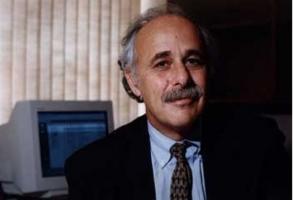
Professor Roberto Peccei has been selected to receive the American Physical Society’s (APS) 2013 J.J. Sakurai Prize for Theoretical Particle Physics, awarded annually to recognize and encourage outstanding achievement in particle theory. He received the award at the APS meeting in April 2013, along with his Stanford University colleague, Helen Quinn.
An internationally renowned theoretical particle physicist, Peccei is the first UCLA recipient of the Sakurai prize, named in honor of a late UCLA physics colleague.
A major contribution to physics is the Peccei-Quinn Symmetry, an elegant theory that ties together several branches of physics and has important implications for our universe. The Peccei-Quinn Symmetry predicts the existence of very light particles called axions, which may nevertheless be the dominant source of mass in the universe. Axions may be the mysterious "dark matter" that account for most of the matter in the universe.
The citation for the J.J. Sakurai Prize recognizes the Peccei-Quinn theory as "the elegant mechanism to resolve the famous problem of strong-CP violation which, in turn, led to the invention of axions, a subject of intense experimental and theoretical investigation for more than three decades."
Peccei, a fellow of the American Physical Society and a professor in the Department of Physics and Astronomy, served as UCLA’s vice chancellor for research, dean of physical sciences in the College of Letters and Science, and chair of UCLA’s Department of Physics and Astronomy.
Born in Italy and raised in Buenos Aires, Peccei came to the United States to attend MIT as a physics undergraduate. He earned his master’s at New York University and returned to MIT, where he earned his Ph.D. in physics in 1969. After a brief period of postdoctoral research at the University of Washington, he joined the faculty of Stanford University in 1971. In 1978, he joined the staff of the Max Planck Institute in Munich, Germany. He became the head of the Theoretical Group at the Deutsches Elektron Synchrotron laboratory in Hamburg, Germany, in 1984 before joining UCLA’s faculty in 1989.
He has served on numerous editorial and advisory boards in both the United States and Europe.
– From UCLA Today
