
Humanity’s current strategies for mitigating climate change are heavily skewed toward industrial, high-tech engineering, such as multi-million-dollar mechanical carbon-capture factories that vacuum carbon dioxide directly from the atmosphere for artificial sequestration: the technological process of capturing and permanently compressing and storing carbon emissions into deep underground geological formations. However, recent scientific breakthroughs prove we have been overlooking a massive, ancient, and entirely natural carbon-capture infrastructure operating right beneath our feet, literally. For over 400 million years, underground fungal networks have silently acted as the planet’s primary carbon sink. The sheer scale of this biological machinery was long underestimated due to the difficulties of studying subterranean ecosystems, but a massive paradigm shift is currently underway in global environmental science.
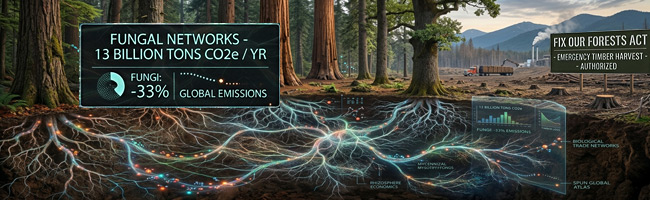
At the absolute forefront of this shift is evolutionary biologist Dr. Toby Kiers, who was awarded the prestigious 2026 Tyler Prize for Environmental Achievement, frequently cited as the “Nobel Prize for the Environment,” for her pioneering work on soil biodiversity. Kiers’ research has successfully quantified the massive environmental footprint of mycorrhizal fungi, which are microscopic, thread-like structures that weave through forest floors and grasslands to attach themselves to plant roots. Her data reveals a staggering reality: land plants allocate roughly 13 billion metric tons of carbon dioxide to these underground fungal networks every single year. This organic drawdown effectively traps an amount of carbon equivalent to one-third of the world’s annual fossil fuel emissions, positioning the fungal kingdom as a cornerstone of global climate regulation.

Dr. Toby Kiers at the Vrije Universiteit in Amsterdam
What makes these underground networks truly remarkable is that they do not operate as passive filters; instead, they function like highly sophisticated economic markets. Through a symbiotic relationship, plants trade carbon generated from photosynthesis in exchange for essential nutrients like phosphorus, nitrogen, and water gathered by the fungi. By utilizing advanced laboratory techniques, including tracking nutrient flows with glowing “quantum dots,” microscopic semiconductor nanocrystals that emit specific wavelengths of light when excited, researchers have discovered that these brainless fungal networks display an uncanny, decentralized intelligence. They act as shrewd economic agents, implementing biological “trade algorithms” that allow them to deliberately restrict nutrients from stingy plants while aggressively routing resources to plant partners that provide higher carbon payouts.
Despite harboring nearly 59% of all global species and playing a dominant role in climate stabilization, these subterranean biomes are completely neglected by modern conservation laws. Currently, an alarming 90% of the Earth’s most diverse underground fungal systems lack any form of legal protection. This systemic blind spot heavily undermines policies meant to preserve forests. When governments authorize the clear-cutting of old-growth forests, the environmental damage extends far beyond the visible loss of timber; it completely collapses the delicate underground “trade grids” that bind the soil together and permanently lock away greenhouse gases, effectively turning a major carbon sink into an atmospheric liability.
This ecological vulnerability is being actively exacerbated by current federal legislative shifts. The aggressive pushing of the bipartisan Fix Our Forests Act (FOFA), compounded by recent executive actions and Department of Agriculture secretarial memos declaring 112 million acres of national forest system land to be an “emergency situation,” has drastically altered public land management. By fast-tracking industrial timber harvesting, expanding environmental review exemptions from 3,000 to 10,000 acres, and systematically restricting the public’s judicial right to block federal timber sales, these policies allow for the extensive removal of large, naturally fire-resilient old-growth trees. The immediate collateral damage of this regulatory rollback is a silent catastrophe: it causes the widespread, unstudied fracturing of the very subterranean fungal networks that stabilize Earth’s climate metrics.
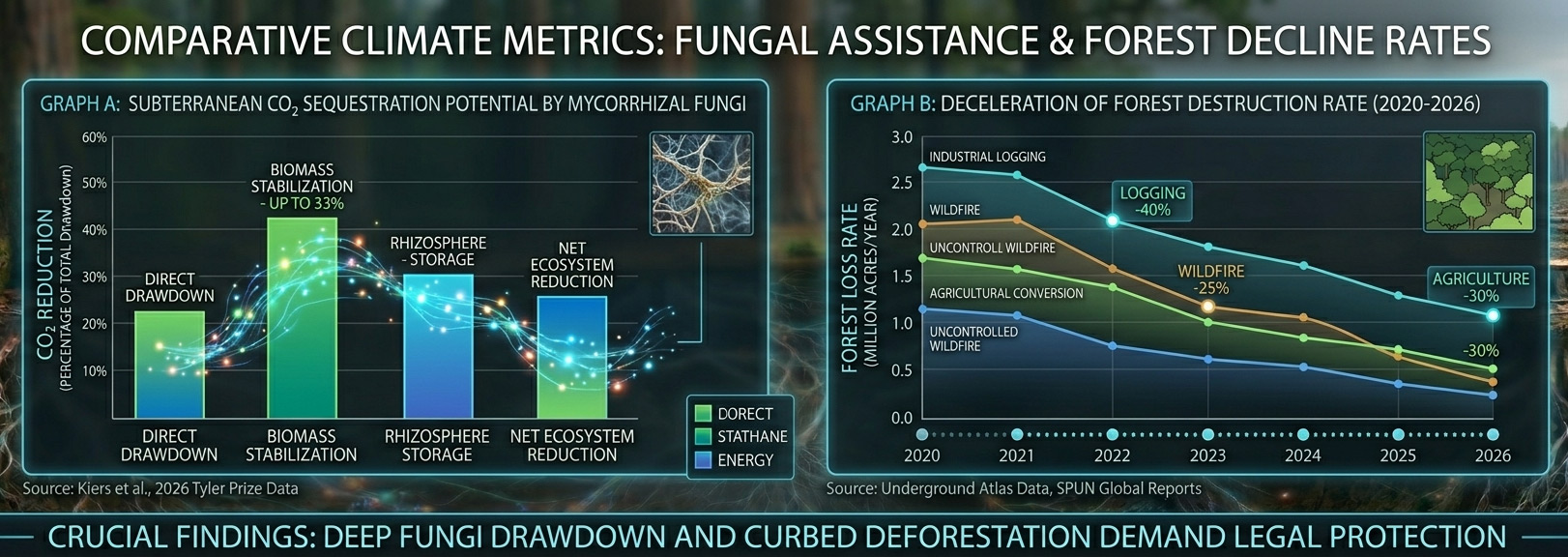
To rectify this deep ecological vulnerability, a new wave of decentralized, tech-driven advocacy is taking root globally. Leading scientists have co-founded the Society for the Protection of Underground Networks (SPUN), utilizing DNA soil sequencing and machine-learning models to map global fungal hotspots and publish the world’s first digital Underground Atlas. Furthermore, a collaborative initiative called the Underground Advocates program has been established to arm regional scientists with the legal and policy tools required to integrate soil biodiversity data into international climate frameworks. Protecting the climate, therefore, requires a profound shift in perspective: we must transition from merely engineering new technological fixes to legally shielding the intricate, living infrastructure that has kept the Earth in balance for millennia.
Sources:
Lessons from fungi on markets and economics | Toby Kiers
American scientist Toby Kiers wins Tyler Prize for shedding light on hidden fungal networks
LifeGate Scientific Review, Environment Nobel recognises fungi that capture CO2 (January 2026)
Mapping underground fungal networks: Interview with SPUN’s Toby Kiers
The Ecologist: The power of fungal networks
Fungi embrace fundamental economic theory as they engage in trading
‘Fix Our Forests Act’ Only Fixes for Logging
Trump Administration Declares “Emergency” to Expedite Logging in National Forests
Images: WJ for ERAScience
Portrait of Dr. Toby Kiers: Peter Valckx; upload by Kpwalther, CC BY-SA 4.0 via Wikimedia Commons
