
Australian Group Announces Development of New Nano-Solar Technology

It may sound coney, but Australian researchers have developed nanocones, a nanostructure material that increases solar efficiency by 15%!

The team of scientists at Royal Melbourne Institute of Technology announced the development of the nanocone, which is a type of nanomaterial that boosts the efficiency of photovoltaics by increasing their light absorbing abilities.

The cone like material works due to it's ultrahigh refractive index—the inside of each cones is an insulator and outside is a conductor—under a microscope the material looks like a mass of bullets stood up on end atop a flat base. Each cone has a metal shell coating and a core that is based on a dielectric (poor conductor of electricity) so a material made with them would be able to provide superior light absorption properties, making it perfect not just for solar cells, but also for a wide variety of photovoltaic applications from optical fibers to waveguides and even lenses. The researchers say that if such a material were used as part of a traditional thin-film solar cell, it would increase light absorption up to 15 percent in both the visible and ultraviolet range.
This is the first time that such a nanocone structure has been created and just as importantly, creating them would not require any new fabrication techniques! Nanocones could be key to making inexpensive solar cells thus taking us another step closer to a lower carbon, clean air life.
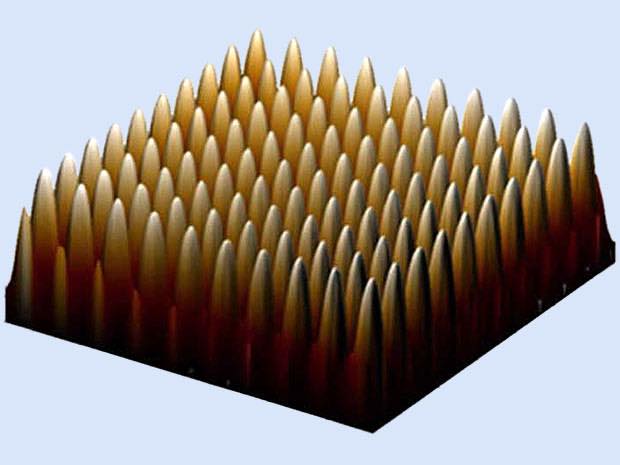
Image courtesy of RMIT UNIVERSITY (https://www.rmit.edu.au/).
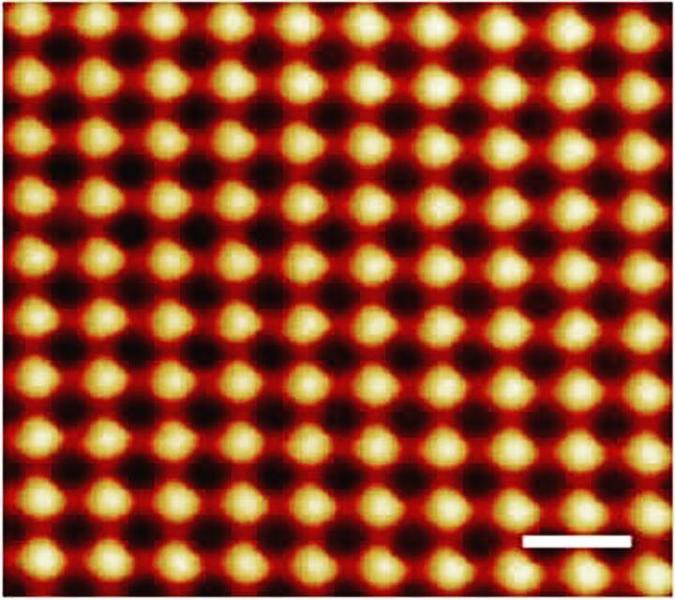
 

Image courtesy of PHYS.ORG.

RSS Industry News

RSS Expert Insights

  • Older and Wiser: How Elder Animals Help Species to Survive
    A growing body of research is pointing to the critical, but unappreciated, role that older animals play in ensuring the survival of wildlife populations. Conservationists say the new findings should lead to policies that protect these elders and the essential knowledge they impart.Read more on E360 →
  • Sustainable Wood Schemes Failing to Slow Deforestation
    Schemes that certify wood or paper as sustainable are doing little to stem the loss of forests globally, a study finds.Read more on E360 →
  • As Oceans Warm, Great White Sharks Are Overheating
    The evolutionary edge that fueled great white shark dominance for millions of years could soon become its greatest downfall.Read more on E360 →
  • Energy Crisis Spurs Global Push for Remote Work
    The energy shocks rippling from the war in Iran have prompted countries, from Cambodia to Peru, to embrace remote work. Leaders in Europe are now joining the push as they look to curb consumption of oil. Read more on E360 →
  • Zambia Under Pressure to Clean Up Shuttered Lead Mine Poisoning Town
    Three decades after one of the largest lead mines in the world closed down, people in Kabwe, Zambia, are still dealing with the aftermath. Facing pervasive lead contamination that continues to endanger their children, families in Kabwe, with a coalition of human rights groups, are calling on the African Union to force Zambia to clean […]