

What does man's carbon footprint into the atmosphere and the cement/concrete sidewalk beneath your feet have in common? A lot it seems, and a team of Researchers at UCLA have a plan to capture carbon from power plant smokestacks and use it to create a new building material — CO2NCRETE — that would be fabricated using 3D printers!
The production of ostensibly innocent cement, when mixed with water forms the binding agent in concrete, is also one of the biggest contributors to greenhouse gas emissions!? In fact, about 5 percent of the planet's greenhouse gas emissions comes from concrete.
An even larger source of carbon dioxide emissions is flue gas emitted from smokestacks at power plants around the world. Carbon emissions from those plants are the largest source of harmful global greenhouse gas in the world.
The UCLA team has been working on the unique CO2NCRETE solution and may help eliminate these sources of greenhouse gases. Their plan is to create a closed-loop process which captures the carbon from cement and power plants and then fabricate the new building material using 3D printers.
"What this technology does is take something that we have viewed as a nuisance — carbon dioxide that's emitted from smokestacks — and turn it into something valuable," said J.R. DeShazo, professor of public policy at the UCLA.
"This project could be a game-changer for climate policy," DeShazo said. "The technology tackles global climate change, which is one of the biggest challenges that society faces now and will face over the next century."
This isn't the first attempt to capture carbon emissions from power plants. It's been done before, but the challenge has been what to do with the carbon dioxide once it's captured.
"We hope to not only capture more gas, but we're going to take that gas and, instead of storing it, which is the current approach, we're going to try to use it to create a new kind of building material that will replace cement."
"The approach we are proposing is you look at carbon dioxide as a resource — a resource you can reutilize. While cement production results in carbon dioxide, just as the production of coal or the production of natural gas does, if we can reutilize CO2 to make a building material which would be a new kind of cement, that's an opportunity."
The researchers are excited about the possibility of reducing greenhouse gas in the U.S., especially in regions where coal-fired power plants are abundant. "But even more so is the promise to reduce the emissions in China and India," DeShazo said. "China is currently the largest greenhouse gas producer in the world, and India will soon be number two, surpassing us."
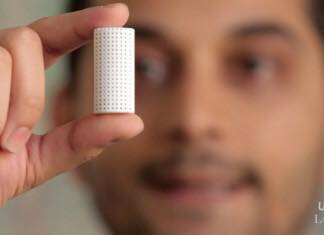
So far the new construction material has been produced only at a lab scale, using 3-D printers to shape it into tiny cones. "We have proof of concept that we can do this, but we need to increase the volume of material and then pilot it commercially."
"We can demonstrate a process where we take lime and combine it with carbon dioxide to produce a cement-like material. We're not just trying to develop a building material. We're trying to develop a process solution, an integrated technology which goes right from CO2 to a finished product."
The global economic impact of the technology is huge. Power plants that turn the smokestack flue gas into a resource their countries can use, to build up their cities, extend their road systems. "It takes what was a problem and turns it into a benefit in products and services that are going to be very much needed in all countries especially China and India." Game changer sounds like an understatement!